Showing posts with label media. Show all posts

Saturday, February 25, 2012

How soon is too soon to start studying the nineties?


....as a decade of cultural failure?

Let's look at this for a moment: brought to you by BuzzFeed, 48 Pictures that Perfectly Capture the 90's.

These pictures are a lot of things--they are funny. They are dorky. They are very, very accurate in capturing the decade none of us could ever forget, because we grew up there.

Besides this--quirky, kind of silly, mismatched, weird--there aren't a lot of adjectives that come to mind when you imagine the 90's. There are a lot of nouns, mostly proper nouns--Lisa Frank! Will Smith! Full House!--but it doesn't seem to have the same niche in our cultural consciousness as many other decades from the 21st century. 1990 was more than 20 years ago, but you aren't going to see anybody throwing 90's themed parties.

It's kind of an indescribable era--one can tell, one can feel, if you will, when something is "90's," but it's nearly impossible to explain why. It was a strange transitional period between the so-bad-it's-good style and media from the 80's, but not quite the shiny tech-laced era we spent the past ten years in. For this reason, as well as others, I contend that the 1990's was a decade of cultural failure.

People will protest this statement--Krista, they will say, what about Rugrats? What about Madonna? And they are correct! There are a variety of good things that came out of the nineties. Let's take a look:


  • Children's television
    • The nineties is characterized by television, namely animated shows on Nickelodeon, and animated Disney films, that were aimed at children but have the vitality to still be enjoyable to those same children today, as they become adults. Finding the balance between subtle adult humor and plots and characters that children would also enjoy was a masterful accomplishment of the decade.
  • Surrealist Music: 


What is happening in any of these? Who knows? What caused the nineties to contain this surrealism? Who knows?


  • Some good movies.
    • Pulp Fiction.
  • Good rap music
    • And for all the good rap, there is some ridiculously bad rap, too. Exhibit A: 
I'm not talking about things that are so-bad-they're-good, because people's opinions on that differ, and to be fair, the nineties is full of things like that. Even so, the quantity of so-bad-it's-good media and fashion in the nineties doesn't nearly reach that of the eighties, and much of it is good for the novelty and the nostalgia, but how much can you actually take? I'm not saying I don't love Saved by the Bell because of how ridiculous it is, and I'm not contending that I didn't watch every episode of Full House when it was on reruns on ABC family--but they aren't quite ridiculous enough to enjoy the way you can enjoy slasher-boom films of the eighties. The Backstreet Boys and NSync are over the top and crazy, but can they even aspire to the over-the-top craziness of their boy-band predecessors like Drop Dead Fred or, more subtly, Tears for Fears? Nineties fashion is hideous, but can it be rocked the way hideous eighties fashion can? 
These women know how crazy they are.
These women think they are normal. 
Further evidence:
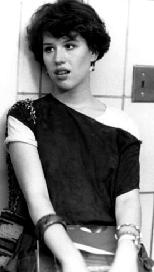
Molly Ringwald looks great, and almost elegant! And young!


Candace Cameron, on the other hand, looks sad and old. 
Something that's really significant about the nineties is that the way we see it today is very much characterized by nostalgia--not any sort of longing nostalgia, just a sort of reflective, laughing nostalgia at how ridiculous we were. How ridiculous we just were, less than twenty years ago.

Before I make my next point, let's not rule out that perhaps there is nostalgia for many decades like this, that I can't relate to because I wasn't there. I do desperately wish that I were alive in the eighties, or the fifties, or the twenties...but I can't feel it like I can with the nineties.

Even so! It seems like we have a lot of nostalgia for the nineties, and not a lot else. The reason there is so much nostalgia, and it is so plentiful, is because we didn't actually take anything from the decade. Sitcoms have been drastically changed since then, children's television isn't anywhere near as good, we moved away from the terrible fashion as much as possible, pop has changed entirely. The only thing we really got from the nineties is...

Oh, right. That.
My friends, hipsters came from the nineties.

You know this. I know this. Fred Armisen knows this. For all the Lisa Frank, for all the cheesy, cheesy movies and fluffy rap, all the good natured, value preachin' sitcoms, we took the sad music and strange clothing from Seattle. 

I mean no disrespect to grunge, don't get me wrong. I love grunge, I really do. And I'm sure Seattle is great. 
Let's break it down a bit.

Grunge came about as a reaction to a lot of bad things that were going on in the 90's. Current events of the decade are marked by domestic bombings and civil war--Columbine, the Oklahoma City Boming, the Rwandan Genocide all happened in the nineties. Our military attention switched from Soviet Russia to the Middle East, where we began fighting a culture that we understood even less. Politics are marred by sex scandals and economic problems, resulting in a mistrust of authority. So what does it say about our improvement as a society that the cultural reaction to these negative things is what endured into the millenium? Forget how obnoxious we may find hipsters to be, their cultural basis is sad, and that says some sad things about us.

QED, the nineties was a decade of cultural failure.


Sunday, February 5, 2012

BATMANTICIPATION

In case you all didn't know, I am a nerd girl.
True life: I'm a nerd girl. Confessions of a Nerd Girl. Hello, my name is Krista, and I am a female nerd.
This is a part of myself that I've been dealing with for some time now, but it's time to share it with the world. I should be proud.
That's right. I'm a dork. I read tons of very culty and strange webcomics. I am excited by video game themed crafts. I listen to They Might Be Giants, Pride, Predjudice, and Zombies is at the top of my reading list, and I can quote Firefly in my sleep.

And I am very, very excited for all the incredibly quirky, campy, nerdy movies that are hitting theaters this summer.

So it's time for a little SUMMER MOVIE PREVIEW. No better way to cure the winter blues, right?

(Nerdy) Summer Movie Preview--2012--Filmpocalypse
April
This April, the movie I am most excited about ever is happening. The Cabin in The Woods. Watch the trailer: 

As far as I can tell from that video, this is a self aware slasher movie (my favorite genre) but it's also somehow also a science fiction movie, has something to do with terrifying government surveillance, zombies (?) a monster in the lake (?) and a curse that happens in the pagan-esque chamber that is apparently in the basement (???)

There really is no way to explain what is happening there. It seems to have all the elements of a good old fashioned cabin-in-the-woods slasher, which it better, considering the title: a group of very stereotypical and unbearable teenagers, a small remote house, a keg, some aspect of zombie or mind control film (a la Evil Dead) and a very creepy gas station with a horrifying hillbilly. 

Side note: creepy gas stations are the only fear I believe I obtained directly from Slasher movies. I drive past about a million run-down convenience stores on my way home from college to get to a Cumberland Farms or a Hess Express, no matter how much I need to use the bathroom or how hungry my car is. Go figure. 

I would be happy enough with a meta-teens in the woods horror film, but this turns that completely on it's head. 

The traditional slasher trailer is about surprise--you begin thinking it's about happy teenagers, at some point, we realize they're getting killed. We aren't surprised by that, we know the tricks. Thus, the traditional meta-trailer: we see the happy teens, we predict the killer, soon after comes some aspect of comedy or a line of dialogue about the self awareness of the film, and we know it's a trailer for the next Scream or Scary Movie (which, unfortunately, is also gracing the screens this April). 

This trailer even turns that convention on it's head--fairly quickly we go through the steps--happy teens, going to a cabin in the woods, dialogue too obvious to believe that we're supposed to take this seriously. And then, without warning--some sort of electrical matrix fence? Girl kissing a deer head? Scary masked men?

And, as if it could get more perfect--Joss Whedon wrote it. The brilliant, nerd-god, Joss Whedon. 

SPEAKING of Joss Whedon....

May: 
Drumroll, please--
To a certain degree, the excitement of this movie coming out goes without saying.

Normally, I'm opposed to contrived sequels, but this, (along with another movie on this list,) is a bit of an exception. Instead of being a sequel it's like the last clue in a crazy filmic treasure hunt, where the first five clues were wonderful in and of themselves.

It took me a long time to gain appreciation for comic book and super hero films, but in a lot of ways they are just like slasher films. The cult following and the campy-ness that they are allowed charms me in the same way that those qualities in horror do. Superhero movies have the character development that the more low-quality slasher movies tend to let slip, and of course, character development is my favorite part of any film. The Avengers will have characters that we've already seen develop, that we, the insane, culty, nerdy audience, will know very well at the beginning of the movie, whether from the earlier films, or from the comics (and the cartoon, which I enjoy.) This leaves room for an entire new level of character development as well as relationship development between the different heroes, which seems to be the focus of the film.

A good friend of mine has told me about how this could set a precedent for other films, to have films take place in the same universe and then perhaps conclude in a massive film which combines the different story lines, which, though I am not educated enough on the subject to get into right now, sounds like an awesome direction for Hollywood to go in right now. Joss Whedon directed this movie, which was a brilliant move on Marvel's part. Those people know their fanbase.

Another note on this film: Robert Downey Jr. is in it. SO. Even if superheros aren't your thing, Robert Downey Jr. probably is.

June: 
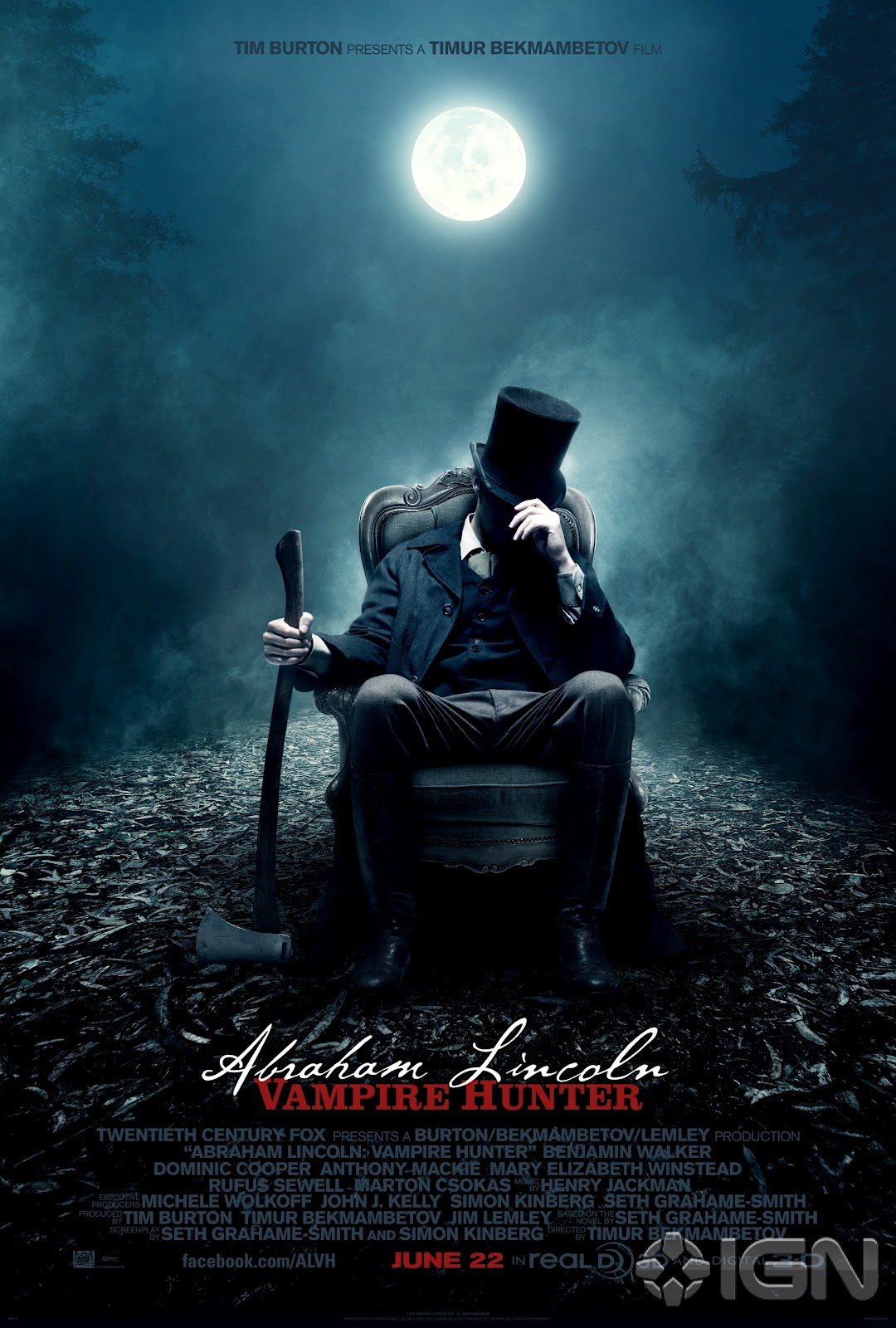
In the new grand tradition of totally insane movie titles comes Abraham Lincoln: Vampire Hunter. 


As previously discussed here on the blog, there seems to be a new trend of having films with titles that communicate immediately that the film is going to be amazing for one of two possible reasons: it will legitimately kick some nerdy movie ass, or will be so completely nonsensical and crazy that it can become a cult classic for his accidental hilarity. Nerdy ass-kicking movies and accidentally hilarious cult classics are two favorite genres of many, many people, most of whom reside inside of the internet.

Unfortunately, not a lot of information is out right now about this film, but come on. Abraham Lincoln slaying vampires. Produced by Tim Burton, hero of dark and strange films, and social commentary. Starring the stunningly beautiful Mary Elizabeth Winstead, my personal celebrity crush.
Three great things that go great together, killing an annoying cultural icon. 
Definitely seeing this one at midnight if at all possible. By myself. Like a creep. A history/horror/nerd creep.


As a side note, Rock of Ages is also coming out this month. This is the only musical I've ever seen on Broadway. I convinced my family to go, because they would know all the songs and they served drinks in the audience. The lead singer of White Snake came on the microphone at the beginning and said only dicks took out their phones during shows. 
The movie is going to either be horrible or amazing. Most likely, horrible in an amazing way. But I'm excited.

July: 
This deserves even more than a drumroll. We need the intro to the Rocky theme for this one. 

Please only listen to the first ten seconds. Ok, we're good.

THE DARK KNIGHT RISES. 
I just watched Batman Begins last week, and I saw The Dark Knight in theaters, and I love them both so much. Christopher Nolan may very well be my favorite mainstream director right now. He should be, and I believe, is, at the forefront of the progression of modern cinema. The man is a genius. His dedication to being as real as possible in his films, and avoiding CGI at all costs, is immensely admirable, and shows through not only in the special effects but also in the overall tone of the movies. Not to mention how intense it is that in Dark Knight, they actually flip an 18 wheeler, they actually blow up a hospital shaped building. It creates a situation where there is no room for gratuitous explosions, which makes all of his blockbusters stand out from other action films. Nolan is also one of the pioneers of the emerging action/romance genre, which is a very important aspect of current cinema, and has taken the idea of a mind-blowing twist at the end of every movie to a new level. 

It is only fitting that Nolan, with all of his dedication to realism, directs the Batman films, with the hero who is really only human. Perhaps it is also the realistic, non-supernatural aspects of the Batman franchise that allow it to be so successful and iconic, and represent cultural ills so well! Batman Begins has some serious undertones of mistrust in the government, very appropriate for 2005, smack in the middle of the Bush administration. The Dark Knight is all about terrorism that we cannot understand, and how properly to fight it (I think, I should look into it more). And here we have the stunningly beautiful Cat Woman, translating the shouts from Occupy Wall Street into whispers to Christian Bale. Lately I've been helping out with some high school English classes, and that's the example I use when I need to explain to them why knowing the political and social events surrounding a story is an important part of understanding literature--"You know sexy Anne Hathaway in the Dark Knight Rises trailer? She's talking about Occupy Wall Street! Doesn't that make the movie more interesting?"

Speaking of sexy characters in Batman, in this we have, as always Christian Bale. 

Forgive me for the side note, but this man deserves some attention. Christian Bale has, in his life, has played Demetrius from A Midsummer Night's Dream, (my favorite Shakespeare,) Patrick Bateman, everyone's favorite serial killer, Howl from Howl's Moving Castle, possibly the most dreamy anime character I have ever encountered, the awesome guy from The Prestige, John Connor in The Terminator, Thomas, the adorable friend of John Smith in Pochahontas, JESUS, in a made for TV Jesus movie, and Batman. The guy is Jesus and Batman. Seriously. 

Aside from the inhumanly attractive Bale, we also have Joseph Gordon Levitt, possibly the only one who can match Bale in attractiveness. These superhero movies are certainly playing to the ladies. Not that they need to. Even if we go for the hearthrobs, but we stay for the realistic special effects, sociopolitical commentary, character development, and cultural satire. 

In conclusion: I'm going to the movies every day this summer. Yes, it is certainly a good time to be a nerd girl.


Monday, December 12, 2011

Chinatown, Roman Polanski, Noir, and a discussion of ART.

Guys, I have been a Noir fiend lately.

I keep going back to watch a slasher movie, but something else on my Instant Queue always catches my eye instead--Scarlet Street, The Third Man, The Stranger, Double Indemnity, the list goes on and on. Noir is like the slasher films of the forties and fifties. Low budget, not necessarily respected in its time, very, very genre-riffic (I just made up that word,)...all fantastic. Perhaps I will blog about the similarities and the importance of low budget movies sometime in the future.

Today, however, I'm going to write a bit about Chinatown, because I decided that I'd watched enough Noir that I'd understand it.

And I think, as much as one ever can understand Chinatown after watching it only once, I do.

Spoiler time.

A little summary for you--as far as I understand, Chinatown is a modern-noir, which is now almost forty years old, but that's fine. It's not shot in black and white, which is very important to the genre, as far as I can tell, but you've got the hard-boiled private eye with all his catchy lines, a Los Angeles that I fully believed was in the forties, the gorgeous, GORGEOUS femme fatale (Faye Dunaway ohmygoodness) and a murder for everyone to get tangled up in.

The standard plot was set up and followed very well, with various surprises around every turn. I suppose the trick to noir is that you have to know the surprises are coming, but you can't know what they are--right? Perhaps?

In any case, that's how this movie worked, and it was thoroughly enjoyable. There was also a big discussion about government corruption and capitalism which I was really invested in, but don't feel any need to get into here. The various societal commentary, the biblical allusions, the structure of Chinatown has been discussed plenty, and unless you're my film studies professor, we aren't going to get anywhere by me repeating all of it.

The thing about Chinatown that hasn't been discussed is the fact that it deals very directly with pedophilia and was directed by Roman Polanski.

This is something I've been trying to grapple with--when an artist has created something brilliant, but done something that our society considers evil, how much are we to separate the artist from his art? On one hand, we want to appreciate the art without it being colored by our perception of the artist, and examine its merits and its impact objectively. However, we also want to maybe see how the artist's moral ambiguities affected his work, and even just give an artist credit for something beautiful they've created regardless how much we disagree with their other actions or even the message they are sending in the work.

I addressed this issue in a play I wrote this year for a class in which D.W Griffiths was a character.  D.W Griffiths made the film Birth of a Nation, the first American feature-length film, which naturally had a huge impact on the ways films were made and distributed. Also, it was super racist and about the KKK.

And, unfortunately, except in very film-savvy circles, that's what he's remembered for, which is a shame, because he made plenty of other movies. Another, more common example in film is Walt Disney--made great movies, changed the way we see animation and television and mice, also was a Nazi.

Do we accept the fact that these brilliant men had flaws, and appreciate their work regardless? Or do we pretend that they didn't have those flaws at all? It's a difficult conundrum, especially when they directly address their asocietal (made up that word tooo) morals in their work, the way Griffiths did with Birth of a Nation or Disney did with Song of the South.


For those of you who don't know, Roman Polanski is largely considered to be a pedophile--in 1977, three years after Chinatown was made, he was arrested for unlawful sex with a thirteen year old girl, plead guilty, and fled to London. In Chinatown, it is revealed near the end of the film that Faye Dunaway's character was raped by her father at fifteen, which becomes a major plot point in the film.

It's fascinating to me that no one has discussed the similarities about this aspect of the film and how they connect to Roman Polanski's sex scandal in the seventies; the girl in the movie was in her early teens, raped by an older man after his wife died. Polanski's victim too was just a teenager, and his wife was killed in 1969.

However, the director is much more associated with the main character than with the character of the father--the background of Jack Nicholson's detective is that he failed to save a woman in his previous career in Chinatown and as a result, she was killed, and he became rather despondent and apathetic. This lines up fairly well with Polanski, who cites not being at home the night his wife was murdered as his biggest regret and says that it left him pessimistic and with "eternal dissatisfaction about life."

Perhaps it is out of respect for Polanski and the film that nobody has made this connection, which would be, in my opinion, the best way to deal with the situation. The crime he committed was a mistake, and the worst of his character, while this is one of the most brilliant things he created, if not the most brilliant. Hopefully, years from now, it will be looked upon as such, and hopefully someday we can look at other artists' work the same way.

Sunday, October 30, 2011

Happy Halloween! Here is a rant for you.

It is, of course, necessary that I write a blog for Halloween.
Clearly I've been neglecting my ponderings on  horror films lately, at least in a formal written out form. Worry not, friends, there is no shortage of heated debates about slasher lore and, now, the local ghost stories here at college. And I know, that, since it is Halloween, I can no longer ignore this blog that was once so well nurtured.

Normally I would write a review of a horror movie, or a general overview of some Halloween movies, or a rant about fake scary movies that they play on ABC family, but I'm going in a different direction.

It doesn't make sense for me right now to review one of the approximate BILLION scary  movies that are on my list of things to watch, because the majority of them are themed with other holidays; specifically, the next movie on my list is Rare Exports, a Christmas-themed thriller, and the next is April Fools, a terrible, terrible slasher. My Netflix Instant Cue opens with New Years Evil and Graduation Day, and, before on the nonsense with Netflix, those two were quickly followed by My Bloody Valentine. Even right here on this blog I've reviewed Black Christmas and Terror Train, both of which take place in the end of December.


There are a whole slew of slasher films that take place on other holidays, specifically Christmas. And, as you probably figured out, there is a lot of controversy over these films. In fact, you may have found even yourself feeling a little bit uncomfortable with the idea of mixing the gory death of teenagers that we love so much on Halloween with the happiness and coziness of Christmas.

A little background: Halloween is considered by many to be "The Father of Slasher Movies." It was wildly successful, making $60,000,000 in about two years with a budget of $320,000. Obviously, great formula: spend relatively little money, make a lot more money, and make a great film. America at the time was ready for it, and, thus, an innumerable amount of movies were made.

The concept was so simple that hundreds (?) of eager indie film makers jumped on the opportunity. Just get yourself a fake knife, some corn syrup and food dye, some cheap, hopeful, young actors, a creepy place, and you've got yourself a film (I know, I've done it). All you need now is a plot, or a theme of some sort--and, riding on the success of Halloween, many manymanymany of the people making these movies decided on a holiday.

Christmas is maybe not the most obvious of all the holidays to choose for a movie whose action is based around the murder of "innocents," but for some reason it became very popular. Movies like Silent Night, Deadly Night, Don't Open till Christmas, Christmas Evil and Silent Night, Bloody Night didn't seem to do any better or worse than other films. Perhaps because the movie that I consider to be the "Mother" of slasher films, and just as good as Halloween, also played a part in the beginning of slasher movies. Perhaps, we can take the cynical view, and say that the producers, directors, and writers were trying to cash in on the controversy that came from making these films, which were often considered a direct assault on family structure and Christianity (don't forget about the New Right shenanigans that were happening in the eighties). Perhaps there are enough angsty people who just need to watch a slasher movie at Christmas to dispel the anger that comes from spending time with laughing children and consumerism. Maybe--and let's go with this one, for the hell of it--the juxtaposition of the violence inherent to slasher films mixed with the happiness that is considered to be inherent to Christmas creates a more shocking and therefore effective film.

The real question is, why are people so accepting for a violent movie on Halloween and so ready to scorn a movie that takes place on Christmas? Christmas Evil, made in 1984, which directly references Carpenter's film in the tagline ("You made it through Halloween, now see if you can survive Christmas"), made approximately two million dollars, with a budget of about one million, in comparison to Halloween's sixty million dollars worldwide. I'm not going to pretend that Halloween isn't a much, much better movie than Christmas Evil, or that the shock value was already wearing off at that point, but still. Fifty eight million dollars is a lot of money.

I think it's an interesting cultural phenomena that we sequester a time of year to be scared, or, rather, to let ourselves be scared. Clearly this intentional fear is part of our culture--scary movies make millions of dollars all year round, not just at Halloween. Would it be better to accept it into our every day lives, like the many hardcore horror movie enthusiasts and self-proclaimed members of the goth subculture that already do? Or, is Halloween, like horror movies, a safe place to keep it so we can live our lives pretending that death and fear are not present?

This has been a Halloween blog post.

Monday, July 18, 2011

A Treatise on Harry Potter

I was five years old when I read the first Harry Potter book, and to this day I picture Hogwarts as the house in which it was read to me; the house belonged to my friend, and it was a significant part of my childhood. It was an amazing house, and reading The Sorcerer's Stone in her yellow-painted bedroom of the three-story, renovated barn is one of the many happy memories I have from the house.

For a long time every book release was quite a bonding experience for her and her mother and my mother and I. When she grew out of it, it became an event that some other close family friends of ours and my brother and I did together, and it was the only time we'd get together. Book, and later movie releases, were bright spots in my mundane summers, where I could have an excuse to sit down and read for a week straight then reunite with childhood friends and stay up late talking and reading and analyzing every aspect of the series.

I was, for sure, as obsessed as anyone--and it's easy to see why. Harry Potter defined much of my childhood, and even to this day, as an "adult" to some degree, who can recognize the literary and filmic downfalls of the franchise, I cried when Harry Potter and the Deathly Hallows Part Two in Imax 3D closed with a three-shot of Ron, Hermione, and Harry. For me, and for thousands of other people in my generation, Harry Potter has been a constant--as, for the class of 2011, who started Kindergarten the year the first book was released and who just graduated, has been school. The painfully obvious tagline--"It all ends Summer 2011--" poetically punctuates not only the end of a series I have grown up with, but the end of my time living in the little town where I was born and going to school with the same group of people.

Regardless of my emotional connections to the story, I wasn't as psyched about this release as other people were, and until I was actually sitting in the enormous IMAX theater, after having waited in line for an hour when I could have been home doing something productive, I didn't care to see the film at all--in fact, I never saw Deathly Hallows Part One. People have been going on and on about how a huge chunk of their childhood is ending, about how a little part of them died, about how it is, in fact, all over, and how much of an effect that is going to have on their lives.

For me, that feeling has long passed. While a lot of people--especially those a little bit younger (current sophomores, my brother's age,) who were five when the first movie came out--have grown up with the films as much as with the books, if not more, definitely see the movies as entirely a part of Harry Potter, I still can't.  I felt the way so many people are feeling now when we got the seventh book at midnight, and when I closed the back cover at one in the afternoon the next day. Equally poetically, it was the summer before I began high school--in a parallel to the story, I was ready to move on.

Of course, not many other people were--HP continued to define our generation, most clearly shown in a pep rally skit performed by my class, the theme of which was, of course, Harry Potter. I saw the sixth movie at midnight, and I, like everyone else, still find the best way to explain many things is to use Harry Potter analogies. ("you know, he said it like...like Ron says to Hermione in the sixth book," or, "Maybe the little boy at the end of Turn of the Screw wasn't killed, it was just a Harry Potter kinda thing," or, "The only parallel to the rise of Hitler is Voldemort.") All in all, though, the franchise and the fandom became sort of a nuisance to me. I have things to do. I am a grown up lady and I won't bother myself anymore with this nonsense.

Not true, of course. But my cynicism of all things enjoyed by the masses has led me to be a lot more critical of the series, and, in turn, the movies.

Part of the brilliance of Harry Potter  is that, for my generation, the books aged with us perfectly. The Sorcerer's Stone is like a gateway book to a lifetime of reading for so many young kids, and The Deathly Hallows is a dark, dramatic, and complicated fantasy. This brilliance also becomes a bit of a downfall for the series, and especially for the poor characters. There's a massive disconnect that comes in the end of the fourth book. The first three stories are whimsical, spooky, and fantastic for children. There's a clear good vs. evil, the plot follows a formulaic, episodic model that's already familiar to the audience (summer, school, Halloween, Christmas, Spring sports, finals, and so on.)

By the end of the fourth book, I was eight, and kind of ready for the shock of an almost main character getting killed by the big bad guy. By the fifth, I was ten, and, even though it was traumatic, almost ready for the angst and death that marks Order of the Phoenix. Almost. What had been a fun and whimsical tale set in a fun and whimsical location was suddenly a story of political intrigue, of abandoned houses and prophecies and such, but still sprinkled with fun and whimsical things like pixies and bogarts and the like. Harry's frustrating and inexplicable angst was somewhat incongruent with the stories we knew.

The sixth book continued with the drama, but at least still at Hogwarts, to some degree; the seventh book could be part of a completely different series. There are two ways to look at this: one, the audience got to old for the fun and whimsy, the universe got so big that there had to be an epic fantasy/war book in order to get things wrapped up, and Rowling wrote the book long after the directors of the films had switched from the lighthearted Christopher Columbus to much darker directors and was being influenced by the style somewhat. This is one of many criticisms, and opens up a discussion about the simplicity of the plot and characters and the simplistic, unchallenging writing, the dependence on a franchise and strong fanbase, and the lack of vitality that the story has.

Alternatively, one can look at the entirety of Harry Potter as following a similar pattern--if with a more Disney ending--as Chinua Achebe's Things Fall Apart, or Greek Tragedies, or Film Noir--because, by the seventh book/movie, the entire world of the three main characters has completely crumbled. As in Things Fall Apart, the majority of the first part of the story is marked by episodic plots controlled by specific dates, dotted with dramatic adventures that make the characters grow some, but in the end, it is an outside force that the characters feel they need to singlehandedly defeat that entirely destroys their way of life.

This is an emotional moment for those of us who are emotionally attached to Harry&company. It mimics our own realization that the world is not necessarily all whimsy and fun, and somethings things to fall apart entirely. Ultimately, the whimsical, wizarding setting of the series is incidental; the stories are about death, what happens after death, dealing with the after life and with mourning; it is about a group of non-muggles who are still mortals, who cannot beat death even though they have infinite luxuries of magic and such. This is philosophically somewhat simplistic, but it hits home for the audience of adolescence who, developmentally, are realizing the idea of mortality themselves. Not only that, but it emphasizes the fleeting nature of adolescense and school; no matter how dramatic it may be, you may only be one white page labeled "epilogue" or one black screen titled "19 years later" away from a pleasant adulthood. Harry's life reflects our own in many ways, and while he says the well acted line that so easily could have been cheesey, to Voldemort, "Let's finish this the way we started it--together!" he says to us, the crazy high schoolers who so many times have banged our heads against a keyboard in sincere imiation of his puppet self, chanting "angst, angst, angst, " who grew up with JK Rowling and Harry&Co fixing our problems:"Let's finish this, the nonsense battle with the world that is puberty and public education, the way we started it way back on the first day of first grade--together!

Overall, the movie itself greatly exceeded my fairly low expectations. IMAX 3D was much more impressive than I expected, and I can now see it as being a tool for innovation in cinematography rather than a novelty tech toy. The combination of light and dark  and long and close-up shots was much better and more balanced than the usual (dark field. dark castle. black dragon. Emma watson. Field. Dragon. Castle. Emma. More Emma. Some castle. Field. Castle. Emma.) They didn't dwell too long on many things, the movie didn't feel drawn out as some of the others in the series do. Helena Bonham Carter had to act like Hermione, which was brilliant. The battle scenes and the epilogue, were, dare I say it, better for me in film form than in the book--again, possibly because Rowling had the films in mind when she wrote the seventh book (all the unecessary description in the epilogue does make it read somewhat like  a script.) The casting for the whole franchise is quite brilliant. I really enjoyed the whole audience clapping when Ron and Hermione kissed, and when Molly Weasley yells, "Not my daughter, you bitch!" I wasn't  even too bothered by the fact that Daniel Radcliffe is 22 and not 17, and that Harry Potter is the most pretentious character in modern film.

Actually, Harry Potter's pretentiousness did bother me, some. I suppose that's something that also plays to teenagers developmental tendency to be as egocentric as a four year old--three characters, your age, who probably fill enough types that you can relate to at least one of them, who are literally the center of the universe. The movies, especially, are very Harry-centric. Fair enough, he is the eponymous character, and, again, the center of the whole wizarding world. But still, there are some scenes--such as snapping the elder wand in half and throwing it into the lake as his average friends stare in disgust--where his haughtiness is just overwhelming. My favorite part of the movie may very well have been when Neville stepped in after Voldemort had allegedly killed Harry and said something along the lines of, "The forces of good don't simply cease to exist because Harry Potter is dead, you guys..." and everyone was like "wait, what....oh yeah! Stuff happened here before the kid was born too!" (Even though, to be honest, as soon as Voldemort said, "I've killed Harry Potter!" I really wanted  Radcliffe to just stand up and yell something like "Think again, bitch! Avada Kadavera!" [or, Voldemort style, ahhvahdah kadahhha!"])

 In my opinion, the most interesting part of the series is the backstory of Voldemort--again, and seriously, it is very close to the rise of Hitler, and feels similar to study--how is it that these villians that we hold in this special, "he who must not be named" spot, in reality or literature, come to be as evil and as powerful as they are? I'd like to see a film directed more around Tom Riddle, personally. I did love in the seventh movie when Harry called Voldemort Tom to his face...that was quite the scene.

The hype is still a little much for me, but again, I do have an emotional attachment. I'm glad that, in the future, even though I won't be able to say I saw any classic bands playing live, I will be able to say that I saw Harry Potter in theaters when it first came out,and got the seventh book at midnight, and lived through a phase of fandom that was, at the time, rivaled only by Elvis and The Beatles.  And I did cry during the film, not only at seeing Ron cry over his brother's body or at the first shot of Dobby's grave, but also when Olivander echoed his line from the first story, "The wand chooses the wizard," and whenever the main theme came in, and in the last shot of the three friends holding hands.

In an emotion that, again, poetically mimics that of Harry himself as he walks into the forbidden forest, I realized walking out of the gluttonous theater that while I am sad, I am ready for this part of mys life to be over--but I also know that it will not be. Literature and film are written about in the present tense, so any day that I want to relive a sleepover in my best friends bedroom in her old house, or the night I stayed up all night with an old pal finishing the series, I can pick up one of the easiest books to read, and Dumbledore and Dobby and Voldemort will still be alive, it will still be up in the air whether Hermione ends up with Ron or Harry, and the terrible epilogue will not yet have occured.

Also, does anybody really believe that WB and JK Rowling are going to stop sitting on that comfy pile of ever-growing cash created by the franchise? I think not.

Friday, July 8, 2011

Writing in the media. What is happening.

You know what's terrible right now?
Ok, bad question. Lots of things are terrible right now. The economy and the war are terrible. Corrupt dictators are terrible. Disease is terrible. Stuff is not looking so good.

Here's what I think is the most terrible: the media.

The state of journalism right now is just sad stuff. Of course, this is why I'm going into journalism as a career--I have an incredible urge to fix it. The whole thing. Fix it all.

Really, though, every day I go into my kitchen and watch Fox News with my father, and as he's laughing at the "clever" commentary or "groundbreaking" discoveries, I just die inside. Every moment that those silly blonde women or the silly man who stands in front of the capital building in Massachusetts and yells about stuff says something else I just see the art that I love descending down the steps to hell.

My thoughts on this are stirred by a conversation I just had after I was accused of getting all my news from Stephen Colbert and John Stewart. First of all, not true. I am a regular news junkie. I get news from those two, but also my Google News Feed, NPR....Wait Wait Don't Tell Me...SNL....The Week...


You may see my problem here--five out of seven of those things are, in fact, news satires. Therein lies the question--where else am I supposed to get news? Satire is the only place where people, instead of talking about all the strange and irrelevant horrible things that are happening, talk about what is happening and how horrible all the people reporting on it are.. Everything right now is a distraction for our bigger problems--we seem to be stuck in an endless loop. Think of the biggest news stories from the past few months. The Royal Wedding? Anthony Weiner and friends? The End of the World?

Short answer--nothing important. Nothing long term. So much is going on right now, and these are the things we've decided we care most about. The big problems, everything from the corrupt medical system to the war to climate change and our depleting oil supply, is pushed into the background. Which, as far as I'm concerned, adds the media right onto that list of big problems we don't want to think about.

Until I was thirteen, I wanted to be the president of the United States. I've since decided journalists are much more powerful. Where on earth would the Tea Party movement be without Fox News or Rush Limbaugh? How many democratic bills do you think would have passed if the conservative media hadn't been so upset and critical? Everywhere we can see evidence of the media--television, specifically--being used in ways that it never has been used before. Look at the perfect case study, Sarah Palin--a governor turned vice presidential candidate turned reality show star who may run for president or vice president again. Better yet, we have Donald Trump, who the country braced itself against/embraced the idea of him as a presidential candidate, even though he has been a television icon for the past decade. Rumor has it that Alec Baldwin, a movie star, is considering running for mayor of New York--hilariously, since he himself is a political satirist. Not even to mention Colbert's Superpac, and his run for president last year jokingly, etc.

The point is, the country is being more influenced by the media than ever before, I might say, and we are influenced by it quite a bit. And if the media most of us were getting was accurate or unbiased, that'd be great. If you're getting your news from the television though, which most of us undoubtedly are, it's almost impossible to do that. You can't check the sources, they are the sources. You can't form your own opinions, the opinions are right in there. Fox isn't going to cover a story of a democratic senator doing something awesome or successful, they're just going to give us twenty four hour coverage of an irrelevant sexting scandal.

And, as much as I hate to get political here (a bit late for THAT now, Krista,) there's an interesting thing about Anthony Weiner and all of his nonsense--would any of that happened if he were a republican?

The reason I watch Colbert and Stewart is because they back up what they're saying. They point out the contradictory things that the other news stations do--which makes it nearly impossible to take the other stations seriously--ironically, since they are literally the serious ones compared to Stewart's comedy.

This is my personal favorite example of a comedian backing up something that they say and contradicting the news giant's own commentary--when Stewart totally destroyed Fox news when they got mad that a senator had compared one of his conservative opponents a Nazi.

Here's where I get to my point--the most important thing, at least to me currently, about being a good journalist with a strong opinion is using your facts. Find them. Put them in your articles. Make it easy for your readers to believe that they are true, even make it easy for them to find those facts themselves. I'm all for fancy rhetoric and style, but you are nowhere, you are nothing more than an arrogant internet troll, if you don't have facts.

There is one website that I read with embarrassing regularity that is actually the best example of journalism that I think is around right now. Nowhere am I more inspired or can I learn more from for both my blogging and my more serious journalism than this site. And that site is--you ready for this?--cracked.com.

I'm not saying, of course, that you should get all your news or trust everything on Cracked, but there's no argument that they provide interesting information in an accessible, hilarious, and intelligent way. I've borrowed a lot from their style in terms of incorporating facts and pictures and captions, which you'll probably notice if you read my blog as well as theirs.

The reason they are so smart is because they do their research and they use technology to tell you about it. One of the reasons I love blogging so much as a journalistic medium is because it's so easy to just throw links into your writing to just about anything. This means that instead of having to present your facts in lengthy paragraphs about statistics that people will just skip over/not necessarily believe, or having to choose what statistics and facts are best from piles and piles of data that support the statement you're trying to make, you can just bring your readers right to the source and they can figure it out for themselves. I've always been impressed with the way Cracked does this, and they're starting to do it in creative ways: take this article for instance, which has a sentence with every word being a link to another piece of evidence. Or this one, which is a perfect example of how much they back up what they're saying with legitimate sources.

A lot of people write Cracked off as a crude humor site, which, don't get me wrong, it certainly is and totally intends to be. Because they have an excessive amount of pictures of scantily clad ladies and NSFW text, they aren't considered to be a very intellectual site. But what are you supposed to do but swear when the state of journalism is so sad that the most innovative and intelligent source of information is a crude humor site?

Perhaps the only other thing to do is get a liberal arts degree with a concentration in journalism and try to fix it myself.

Thursday, June 23, 2011

Classic movies--priceless?

I just bought one of my favorite movies, one of the most influential movies of all time, Bonnie and Clyde, for five dollars. My friend and I were at Wally World, buying some blank DVD's on which to put our latest slasher creation (more on that later,) and there was a big bin of movies for five dollars--the best place for finding terrible low budget horror films, which I love. The bin was not organized in any particular way; simply a three foot wide, royal-blue, mesh cylinder filled to the brim with cheap entertainment. And buried somewhere in the pile was the classic, Bonnie and Clyde.


The good thing about this is, I now own and hour and a half of Faye Dunaway and I didn't even spend as much as I would have to buy a small sandwich. The bad thing is, this terribly important movie was tossed away into this bin and that isn't how movies should be treated.

This makes me displeased about, well, the way movies are presented to us that so many people just accept. A lot of things make me displeased about this, but this particular incident is a nice punctuation to my thought sentence that warranted a blog post about it.

According to my very intelligent film studies teacher, as well as, well, film studies in general, Bonnie and Clyde is a pretty important film. A super important film. It changed how violence was depicted, it cemented the place of two legendary cultural icons, it launched Fay Dunaways career (guys, I LOVE Faye Dunaway. She was the most beautiful woman in the world in 1968,) it won too many awards to count, it changed cinema (and America? yes?) forever. It is not only a classic, it is one of the few movies that I think can be considered one of the classics. But more on that later.
Is it right for this movie to be thrown in a bin while other, more recent movies like Red Riding Hood or Gnomeo and Juliet are displayed and played on display televisions? What message does that give?

Considering how many mainstream audiences seem to feel about old movies, in that, they refuse to watch them or understand them in context, it gives the message that old movies are unimportant and new movies are important. It's amazing how many of my very intelligent friends believe that many movies coming out today are brilliant and amazing, but also refuse to watch or respect anything made before their lifetime--where, I think, many of the best movies were made.

Obviously, this is a necessary marketing technique to keep the movie industry running--arguably we should sometimes end up with a movie that has the potential to be a Bonnie and Clyde forty seven years from now, and without all the stagnant movies in between that wouldn't be able to happen.

However, classic films such as Bonnie and Clyde are a part of our culture--nearly just as much as classic literature--or, as much as I'd hate to see this, more in upcoming generations. So much so, I believe, that major cultural and educational changes in the way we look at film are warranted: at the very least, stores selling films should have a "classics" section where films like this are displayed and treated with the respect they deserve. Really, they should be displayed with other films and noted as being more important--slap Bonnie and Clyde next to Fast Five on the shelf with a note: Vin Diesel wouldn't be allowed to carry a gun if this movie didn't happen. At the most extreme level of treating these movies as culturally significant, I think film should start holding more weight in regular school curricula. Not only would this connect to literature--it is hard to find a modern cultural facet more influenced by literature than film--it would provide a basis for understanding so much about our popular culture and social culture, just as literature does. I'm certainly not saying that traditional English classes should be replaced by film studies classes, (even though I do have my own issues with traditional high school English classes,) but I think we're going to begin seeing, if we haven't seen already, film becoming an even more massively important part of our culture--it is very possibly already as important to us as books were important to the centuries before us (please, oh culture lord in media heaven, do not let films replace books.) Film is also a fantastic way to learn about history--there needs to be more emphasis on modern history in schools, as well, and there is no better way to learn about life in a specific time than to watch a film, fictional or non fictional, from then. There are so many cultural references and segments of history that I understand because I had the opportunity to take a film studies class and therefore watch a lot of great films that I may not have watched otherwise--however, not everyone has that opportunity.

Which brings me to my last point, another good thing about Bonnie and Clyde being on sale for five dollars at Wal-Mart. If movies are just as culturally relevant and important as books, then they should be readily available to everyone--even though being buried at the bottom of the five dollar film bin isn't exactly readily available. I'm somewhat appaled that this fantastic film was selling for so little while standing next to some Katherine Heigle formla film being sold for probably four times as much. However, part of me feels like movies this important should be available for free--like classics on Kindle. We are only three years away from the 100 year anniversary of the first full length feature film, meaning, I believe, if it were in book form, it would enter the public domain. It's only so long before lots of influential films gain that status--and should the same idea be applied? Should Itunes advertise free classic flims, to encourage young people to watch them? Should they just advertise them anyways? (yes.) Does making these films cheap make them more accessible or simply lower them to a status below new unimpressive films and next to low budget horror movies? Can any price be put on viewing a piece of culture that affects much of our media today? Is culture truly priceless?

I'm conflicted about it, but regardless: Bonnie and Clyde. In a five dollar bin. Seriously? Get with it, Wal mart and customers.

Also, Faye Dunaway in the sixties. So beautiful. 

Monday, April 18, 2011

Regular posting? Whatt??

Someday, I will be a real blogger.
I also might get a tumblr. More appropriate for sharing this type of thing:

I am in love with this man. Honestly, probably one of my heroes.

The man makes Cabin Fever and Hostel, two gratuitously gory films, directs 90% of Cabin Fever Two: Spring Fever, a film almost entirely based on images of rotting flesh, mentors one of my favorite new directors, Paul Solet, and this is what he's afraid of:

""Fanaticism, in any form, terrifies me. Fanatical devotion to a cause — religious, political, social, even sports teams, often becomes an excuse to let our most violent sides out. When people see others around them that feel the same, they believe in their cause so strongly that suddenly the regular rules of society and behavior stop applying to them, and their actions feel justified because everyone around them feels the same way." (Read the rest here

*Squee!* That's what I'm afraid of!!

Aaanyways, that comes from a list of answers by people that Time magazine has determined in our society to be "scary..." I shan't get into an interpretation of that right now.

*swoon*

Sunday, April 17, 2011

I'm sorry I doubted you, Wes Craven (with some spoilers.)

(Correction--a dear critic corrected me, saying that there are A LOT of spoilers. So be warned about that.)

Thank you, Wes Craven. Thank you very very much.

You have pulled it off.

I have just returned from actually viewing Scream 4, as opposed to just judging it...

It MASSIVELY surpassed my expectations. I should not have doubted Wes Craven's ability to be amazing.
I am sincerely impressed.

Furthermore, I don't even know where to start with this film--besides being accessible for a genre audience, it's actually a really challenging film critically.

Spoiler alert.

The film starts out with what you'd expect a Scream film to start out with--two stupid girls picking up the phone and being subject to murder by a stalker. The title rolls in--Stab 6. What?

Ok, cute. Wes Craven's doing a sort of Nolan-esque thing, starting us off in a film within a film. Two blonde girls, (actresses whose names I do not know, but who were recognizable,) sit on a couch, discussing the metaphysics of horror films. In an amazing way, I might add--I was very pleased to find that the movie was mostly self aware even to the point that it was discussing the now overdone cliche of being self aware in a horror movie, and making fun of overly long franchises, which, now that it has left trilogy status, Scream has technically become.

Suddenly! One of the girls is killed in a rather creative way, but the killer is also revealed--we are confused. Don't we have an hour and forty seven minutes left? How come you just killed her? Regardless, I was totally willing to watch the movie with the new introduced plot .
BUTWAITTHERE'SMORE. Another title, Stab 8, rolls onto the screen, and the camera again zooms away from a flat screen television onto to more girls sitting on a couch.

What. What is happening. My mind has exploded. So great. The new two girls discuss Woodsborough, and the fact that the Stab movies are based on Sidney Prescott, (introducing the fact that the Stab movies are the Scream universe's version of itself,) and set up the fact that it is the anniversary of the plot in question. Both girls are killed, more dramatically than any of the previous, and we are pounded with the dramatic white block lettering of our real title, with much more of an impact than it would have had when the other titles rolled onto the screen.

Perfection. It was rather ridiculous, but it was clearly supposed to be ridiculous. It set up for the almost all of the major themes in the film, such as
-self awareness in movies
-making fun of franchises, therefore, making fun of itself (more self awareness)
-the importance of movies in culture/a microculture
-the importance of culture's influence on movies
-the fame of Sidney Prescott's story in Woodsborough
-whether or not it is a good thing to turn tragedy into horror
-how awesome Wes Craven is.

These themes were, of course, continued strongly throughout the rest of the film. The media was analyzed and criticized appropriately; the current generation received the same treatment. Particularly under examination was technology--from the first minute of the film, we saw stupid teenagers using facebook on their cellphones (/iphones, yay product placement!) and getting killed immediately thereafter. The trouble with identity  confusion that can come from  a digital world where everybody is inherently connected to their phone number and facebook account was used  to an almost Shakespearean level.

This, of course, made it more difficult to find out who the killer really was--as per usual, everyone was a suspect, but having phones constantly stolen from supposed "victims--" and we know that, in this franchise, you can never really believe what you see--made one wonder who was at the other end of the text message.

Technology was also used with plentiful webcam views, which was overemphasized in ads, but still an important part of the movie and very effective. Particularly poignant was one drunken victim, watching the live feed from his handheld webcam on his phone--so he saw the killer in the screen before he did in real life...still on the screen.

There's one big thing I want to discuss that is a HUGE spoiler, and I'd really hate to ruin it for you, but I will--the killer is female. I won't name names, because I was actually really surprised. Craven leads us so brilliantly to believe that he's doing the same thing he did in the original--and since, in this movie, all the characters have essentially seen the original, in the form of the fictional Stab, they too believe that the killers will fit the same type. I did know something fishy was up--the suspect boyfriend's character was never developed quite enough, and the actual killer was weird throughout the film--something I simply attributed to bad acting.

Having the killer be female is a huge statement for horror film. It isn't as if this is the first time we've had a female killer, but having it be so otherwise traditional, and having the victims still be female--was quite intense. This is, at once, empowering and victimizing to the female character, in positive and negative ways. Scream has always been the most empowering slasher franchise for women, I think, because you don't have to do any sort of analysis to understand the survivorgirl status of Neve Cambell, emphasized by her ridiculously badass, almost action movie-esque clincher lines. However, this is particularly empowering--although the movie focuses a lot on whether Sidney is a victim or not, as a (apparently still virginal? quote, "Sidney's problem is that she never gets laid," so it would appear so?) woman, but it is clear that women are not only victims because the aggressor is also female.

However!! The female killer has been created, ironically, by Sidney herself. Her motives lie in wanting to live up to Sidney's fame, in a world where fame doesn't necessarily come from talent, but from "having f*cked up sh*t happen to you," a technique which Sidney is a perfect example of--but that rings very true in our culture today. The killer is ultimately a victim of Sidney's victimization.

Most importantly, I think, this movie discusses in depth the "new rules" of horror. Wes Craven has as much authority to discuss these as he did to discuss the "old" rules, having remade many of his movies himself. The basis of the new rules is that, to successfully scare audiences, you have to reverse the old rules. You must anticipate the audiences expectations, and simply destroy them. This new movie does that, and discusses it, very effectively. The beautiful irony is that, arguably, the original Scream is what nullified the "old rules." Once a movie like that comes out, revealing all the secrets to the audience, essentially, in an official sort of way, you can't seriously make a film that follows those same strategies.

The thing that Scre4m doesn't discuss is that you still do have to adhere to those old rules, somewhat, to satisfy the audience. No, they're no longer pleased with a straight up slasher, but they do still want that moment of "don't open the door!" that characterized the old films so much. In a genre with as visible a progression as the slasher genre, it is almost impossible to make a film without paying homage to the other movies that made that one possible--even this movie has at least three shout outs to Psycho. Audiences expect that nostalgic feel when they see a slasher movie, and this one puts that out there very effectively.

My favorite thing about this franchise is that it points out to a mass audience something that I already know. By being presented as a real horror film--ie, one in which all the characters, in it's own universe, are real and to be taken seriously--but also discussing every step of the plot, it shows something very important that any genre fan believes--we are all, essentially, living in a movie.

"I judge life by its cinematic counterpart. It makes it worth the seven dollars I paid to get in." -ZS 

Saturday, April 16, 2011

Just how much can Leonardo di Caprio hallucinate in one year?

Newspaper-style review for my Journalism class: 


It seemed that, in 2010, the bar was set fairly high for films to shock their audiences with extreme realism in animation and special effects or over-the-top plot twists. This, of course, is a brilliant way to have a film become “what everybody is talking about.”
            The best example of this is Christopher Nolan’s Inception, where the audience is left wondering what parts of the movie were simply figments of main character Leonardo DiCaprio’s imagination. But before audiences were left to wonder what scenes in Inception took place in DiCaprio’s head, they were left to wonder which scenes in Shutter Island took place…in DiCaprio’s head.
            Shutter Island, directed by Martin Scorsese, came out in January of 2010, five months before Inception’s high-grossing release. It follows the story of Marshall Teddy Daniels, (played by DiCaprio,) who is sent to an isolated island off the coast of Boston to investigate the escape of a mental patient from a somewhat experimental criminal institution. He is given a new partner, Chuck Aule (Mark Ruffalo,) for the job, and the men trudge through the gray weather of the Atlantic while discussing their military history in thick Bostonian accents. Soon after reaching the island, they learn that things have gone amiss.
            The thing that people talked about most in this movie was the plot twist in the end, which is almost Shyamalan-esque. Scorsese very effectively leads up to this, and setting the audience just a bit off balance throughout the film. Within thirty seconds of reaching the island, DiCaprio and Ruffalo are greeted by guards armed with loaded machine guns. The escaped patient leaves both pairs of her shoes in her room when she flees. All of the patients in the asylum are very clearly reciting their testimonies from a script. And when our dynamic duo tries to leave the island, DiCaprio’s hallucinations of his dead wife, and then a severe hurricane, stop them.
Unfortunately, regardless of the build up, the twist is quite disappointing—in my opinion, the disconnect from the main story is too great and it ends a foul taste to the end of the film. The point of view even changes; throughout the film, we follow along with the adventures of DiCaprio in a series of flashbacks and intense close-ups, but when the twist occurs, the camera turns on a dime and we spend the rest of the film looking, confused and almost accusatorily at the main character.
            The plot arc in the rest of the film is that of a typical psychological horror downward spiral, with his hallucinations of his wife and gory, grainy flashbacks to the German war camps becoming more and more severe as the movie progresses. This is brilliantly foreshadowed, and the central theme of the movie embodied, in a single line: when the local sheriff describes how rigorous the security measures are for “Ward C,” the building for especially violent patients, DiCaprio replies, “You would think insanity was contagious.”
            This, as well as the paranoia that comes with a film taking place in 1954, is what I consider to be the best part of the film. The plot is threaded through with straight-up Cold War crazy, which interacts beautifully with the themes of insanity intrinsic to a film taking place in an asylum. About half way through the film, DiCaprio essentially abandons the task of finding the escaped patient and instead focuses on uncovering the government conspiracy and medical experiments he is convinced are taking place on the island. His lunacy is fed by his post war paranoia that Nazi like experiments are happening at the hospital, and uncited evidence that HUAC is funding the project. Juxtaposed with this is the unwavering hallucinated image of the wife, dressed in a perfectly housewifely yellow dress, and the marshal’s occasional descriptions of and flashbacks to their picturesque suburban life together. The subtext of the movie, which I consider to be much more fascinating than the puzzley plot, exposes the ugly underbelly of paranoia and fear that is such an important part of the era that we remember as I Love Lucy and Leave it to Beaver.
            Even though Shutter Island and Inception have similarly twisty plots, Leonardo DiCaprio, beautiful cinematography, and hallucinations of tragically dead wives, the former made about half as much money as Nolan’s blockbuster hit. This has a lot to do with the marketing of Shutter Island, and the fact that it’s somewhat in between genres; it has the romance that directors are trying to work into “masculine” movies to appeal to a female audience (plus Leo), it has the plot characteristic of a psychological horror, almost (but just almost,) enough guns and explosions to be an action movie, and enough historical references and implications to be historical fiction—and it was marketed as a slasher.
            However, considering the reputation of Scorsese and the quality of this film, it certainly deserves more credit than it was given when it was released—though the failed attempt at mind-blowing plot twist does take away significantly from the film, it redeems itself with the thoughtful themes of insanity and paranoia. It was over shadowed by Inception, but in terms of plot, visuals, and especially the nearly identical performances of Leonardo DiCaprio, this movie should have earned just as much credit as the Oscar winning box office hit. With the plot twist, this film gets a three out of five stars, but if we were just rating the first hour and forty five minutes, I’d give it a solid four. 

Thursday, April 14, 2011

Scre4m

My friends.
Hello.

Have you seen this nonsense?

Scream is one of my favorite movies, so I'm pretty excited about Scream 4, or, in the grand history of giving ridiculously punny titles to sequels, Scre4m.

But this is not good. Not good at all.

I wasn't really alive and/or old enough to watch movies when Scream came out, and I've gotta be honest, I haven't seen the two sequels preceding this one. I think, however, I have approximately the same love for slasher movies as somebody who went through the eighties, where slashers were a much larger staple of pop culture, so I get Scream. All of it. I get all the references to earlier films, I get how amazingly brilliant Wes Craven is to be able to essentially stare into a mirror with this movie and laugh at himself. And I get that slasher movies were at a point that, well...they needed to be addressed. I've talked about satire before, and how once a genre can have that much self-recognition...well, that's just awesome. And Scream is the perfect example of good satire--as opposed to Scary Movie, which was made by comedians, Scream was a movie making fun of horror movies by the veritable duke of slasherdom.

And even as those VHS's of the movie unwound more and more jokes and self-mockery, they also addressed some of the moral issues with horror film--and whether or not watching slasher movies makes people into serial killers, the lessons they potentially teach, the carelessness of the characters, etc.

It was the wicked awesome hat on the fantastic body of slasher film that was the created in the 1980's.
If you want to get technical, it was this hat. For obvious reasons 
But I'm really not sure about this Scre4m business. I don't know if it is the right time.

It's been eleven years since the last Scream franchise film. That last film, titled simply Scream 3, (aw, come on, not Scr3am?) made as much money as the first film (about 161,000,000,) but had almost three times the budget, and was only four years away from the first film, meaning it could still succeed only on the momentum of it's predecessor.

Obviously, this isn't really the case anymore. The audience for slasher movies is today, as it has always been, teenagers--and, as a teenager, I can say that Scream wasn't a huge part of my childhood, since I was three years old when it was released. If I wasn't into slasher movies as much as I am, I'm not sure I ever would have watched it.

So that's one big issue--audience. The people who liked slasher movies when Scream came out--ie, the people who were teens in 1996--are now in their thirties. With children. And stuff to do. The people who liked original slashers when they were teenagers, and therefore could understand Scream when it came out for it's brilliant satire, are now in their mid to late forties. Teenagers now were toddlers or zygotes when the original came out. Who exactly are they thinking is going to watch this film?

Well, apparently, they think they're going to get the current teenagers, because they're marketing it like they would market any other slasher film today. And to be fair, a good chunk of the slasher movies recently have been remakes, and there have been quite a few remakes in my teenagerdom--Rob Zombie's Halloween came out when I started high school, and since then we've gotten remakes of Friday the Thirteenth and Nightmare on Elm Street--in correct chronological order, even. I suppose it is part of the natural order of things for a Scream remake/sequel to come out.

I think they're marketing it all wrong, though. Again, I haven't seen two and three, but I believe that the tone of  the first one is meant to be relatively lighthearted. And, like so many slasher movies of the millennium, this one is, at least visually, very very dark. The original is witty and self aware, this one seems to be taking itself very seriously. The first one banks on a cultural knowledge of slasher movies as a staple of film...and do we have that any more?

The thing is, the first glimpse of slasher movie culture and structure that most of the kids in my generation get is Scary Movie, which is parodying scream--which is a parody. Could you possibly be less classy? I can't even imagine the confusion that seeing this movie would cause for someone who has seen Scary Movie but hasn't seen Scream--probably most of their key demographic, my peers.

That is the most important question in whether or not this movie will succeed as anything other than a cult hit. Does my generation have the correct understanding of slashers to "get" this movie? Does this movie simply assume that they don't, and as a result have decided to turn this into a film that takes itself seriously, with the only satire left having the killer constantly ask, "What's your favorite scary movie?" and turn his murders into a game, which is actually a horrible premise if it isn't in context? Can the Ghostface killer stand, ungrounded, with no basis in actual knowledge of slasher lore like the original killers had, but only knowledge of the mythos in the movie based on the original lore?

Let me clarify what I mean with this infographic.

Good luck with this one, Wes Craven. You have gotten yourself into quite a bind. 

Thursday, February 17, 2011

A little bit of cannibalism in pop culture!

So lately, both against and of my free will, I've been listening to the song "Cannibal" by Ke$ha.
I'm not a huge fan of autotuned pop, but I like Ke$ha.Her music is catchy and she's kinda adorable.

To be fair, I kind of despise the way she's marketed--hearing children singing "I brush my teeth with a bottle of jack," is disgusting. But I do respect her motivation, even though I don't always respect the outcome--like a  few other pop singers right now (Katy Perry and Lady Gaga, who, I must say, are my top two in this new trifecta of hot pop singers trying to be edgy, and whom I think are much more successful in their edginess,) she is trying really hard to break boundaries, push the envelope. To make inappropriate things appropriate. And I love that. I also love about these new edgy pop stars is that, for the most part, they know how ridiculous they are--though perhaps Ke$ha the least of the three--and therefore, are somewhat satirical. Especially Lady Gaga.

Regardless, this girls music is painfully catchy, and I can't help but enjoy it. And, like I said, she is young and cute and creative. Were I a pop star, I'd probably be Ke$ha.

That's a huge lie. I'd be Ke$ha, but I'd wear less make up and sing about knitting, ice cream, and stage managing instead of drinking, partying, and being a prostitute.

Because rehearsal-don't-start-till-I-walk-in
Also, I'd like to think I'd be Katy Perry, but that's very wishful thinking.

In any case, I think Ke$ha wrote this song to be edgy. What's more taboo than cannibalism? She even goes so far as to obliquely reference Hannibal Lector, (I want your liver on a platter...maybe?) and then even farther, referencing Jeffrey Dahmer. Are we over that yet, as a country? I'm not sure. To add to the edginess, she also refers to herself as a stalker, and says she drinks tea. Which isn't very trendy or alcoholic. 

But I am here to say, dear Ke$ha, that though you think you're being edgy, you are not alone in writing songs about cannibals. You, in fact, are just the most recent in a long tradition of writing songs about cannibals. 

And believe me...I listen to a lot of music about cannibalism. Here I am to share it with all of you. 

First, Voltaire--


Then there is, of course, a bit of Jonathan Coulton...this one is more about Zombies, but still...humans eating humans 


And Creature Feature...
(the kid who made this would be my friend if I knew him, I think)
Here's one by the lovely Tom Lehrer....a love song, no less! 


We, of course, can't forget this:


And this may be my personal favorite. (Ok. The previous video is really  my favorite but I love this one too.) This is Toto Coelo:
And with that, we are back to analysis of trashy pop! I don't really understand Toto Coelo, as much as I love them, but I have to think they were going for something along the lines of what Ke$ha is going for--catchy music about horrifying things, that will make her stand out. This song was the band's only hit, (besides Dracula's Tango) and it's probably because people thought it was so..well, funny. The music video is sexual, but in a kind of hilarious way. It's so over the top taboo that you can't help but find it laughable. 

And I suppose that is what Ke$ha is going for as well--but honey, these amazing old ladies beat you to it. 
But keep up the good work.